AI Identification
Culex
100%
CUL
✓ Verified
ai_vision
Specimen Biology
| Life Stage | adult |
| Condition | good |
Collection Data
| Site | CMS Pond |
| Collection Date | 95 April 2026 |
Preservation & Curation
| Preservation | dry pinned |
Imaging
| Body Part Imaged | whole body |
Researcher Notes
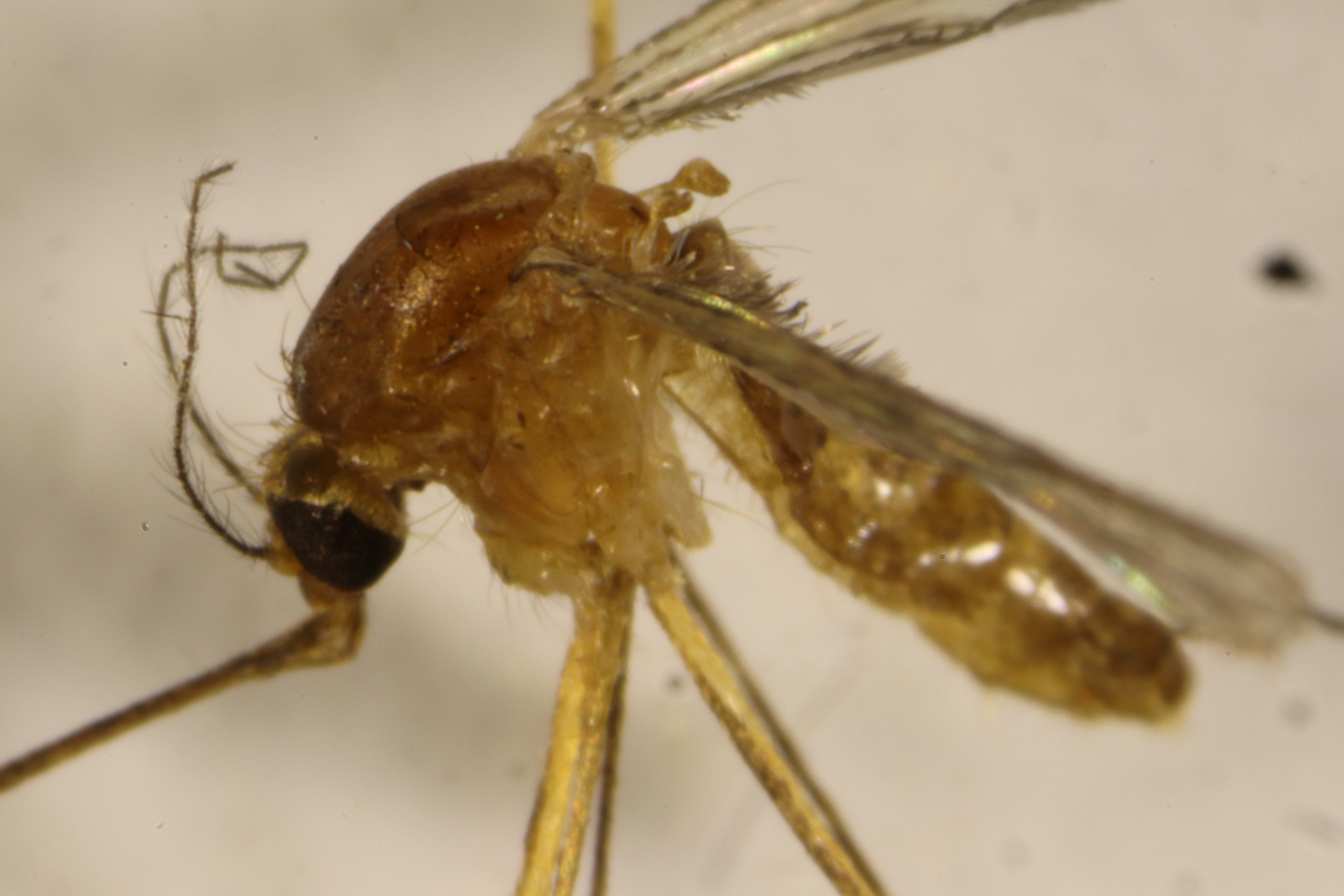
Lateral/oblique view of a small to medium dipteran consistent with Culicidae. Key observations: (1) Scutum appears uniformly brown-amber without lyre-shaped silver markings or strong pale stripes, ruling out Aedes s.s. and Stegomyia complex; (2) Wings appear translucent/clear with uniform brown scaling and no mottling or spots, inconsistent with Mansonia/Coquillettidia or Culiseta; (3) Palps appear distinctly shorter than the proboscis, ruling out Anopheles (which would show subequal palps in females); (4) Abdomen visible on right side shows what appears to be a blunt rounded tip with narrow pale basal banding, consistent with Culex rather than Aedes (pointed abdomen); (5) Legs appear pale yellowish-tan without bold black-and-white banding, inconsistent with Aedes/Stegomyia; (6) Overall size and coloration — amber-brown thorax, no metallic scaling — fits Culex well. Body appears somewhat compressed/damaged. Confidence is moderate rather than high due to: specimen appears partially damaged or desiccated distorting proportions, abdominal tip not fully visible, leg banding details difficult to resolve, and overall image quality limits fine character assessment. Species-level identification not possible from this image alone without wing venation details, scutal chaetotaxy, or male terminalia.