AI Identification
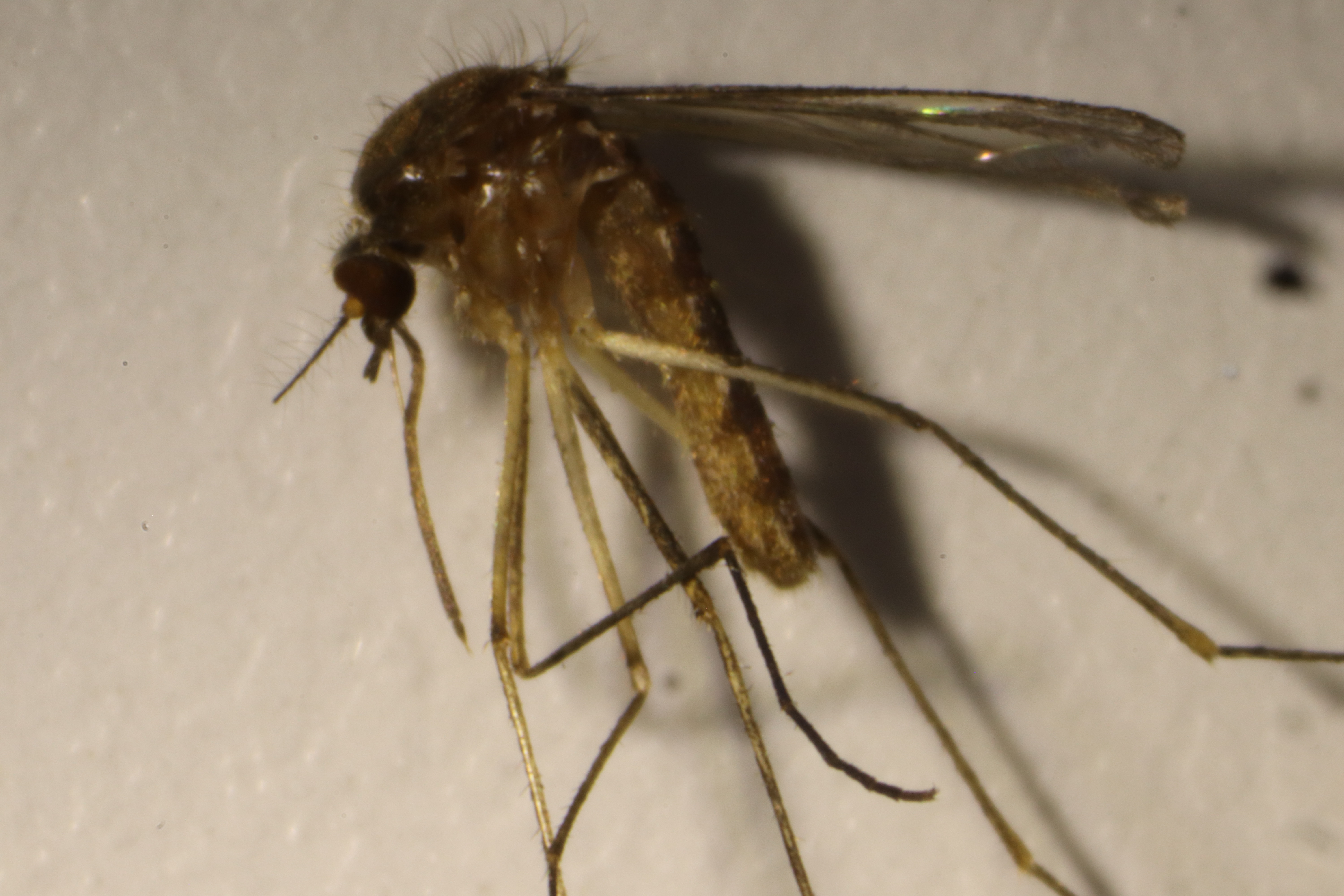
Culex
100%
CUL
✓ Verified
ai_vision
Lateral view of a medium-sized culicid with several features consistent with Culex: (1) Proboscis is slender and straight with short palps clearly much shorter than the proboscis, ruling out Anopheles; (2) Wings appear clear/uniformly scaled without bold mottling (ruling out Mansonia/Coquillettidia/Culiseta) and without spotted patches (ruling out Anopheles); (3) Scutum is brown and uniform with no lyre-shaped silver stripe pattern (ruling out Aedes s.s./Stegomyia); (4) Legs are brownish with only weak/indistinct pale banding — no crisp black-and-white rings characteristic of Aedes or Ochlerotatus; (5) Abdomen appears to have narrow pale basal bands on dorsal tergites and a blunt, rounded tip, both hallmarks of Culex; (6) Body size appears medium (approximately 4–5 mm). The specimen is photographed at lateral oblique angle with moderate depth-of-field limitations obscuring fine scutal and leg scaling detail, preventing confident species-level assignment. Most likely a member of the Culex pipiens complex given the geographic probability and morphological generality, but species confirmation would require examination of male genitalia or molecular analysis.
Model: claude-sonnet-4-6
• 95 Apr 2026
Specimen Biology
| Life Stage | adult |
| Condition | good |
Collection Data
| Site | bfs |
| Collection Date | 92 April 2026 |
Preservation & Curation
| Preservation | dry pinned |
Imaging
| Body Part Imaged | whole body |
Researcher Notes
Lateral view of a medium-sized culicid with several features consistent with Culex: (1) Proboscis is slender and straight with short palps clearly much shorter than the proboscis, ruling out Anopheles; (2) Wings appear clear/uniformly scaled without bold mottling (ruling out Mansonia/Coquillettidia/Culiseta) and without spotted patches (ruling out Anopheles); (3) Scutum is brown and uniform with no lyre-shaped silver stripe pattern (ruling out Aedes s.s./Stegomyia); (4) Legs are brownish with only weak/indistinct pale banding — no crisp black-and-white rings characteristic of Aedes or Ochlerotatus; (5) Abdomen appears to have narrow pale basal bands on dorsal tergites and a blunt, rounded tip, both hallmarks of Culex; (6) Body size appears medium (approximately 4–5 mm). The specimen is photographed at lateral oblique angle with moderate depth-of-field limitations obscuring fine scutal and leg scaling detail, preventing confident species-level assignment. Most likely a member of the Culex pipiens complex given the geographic probability and morphological generality, but species confirmation would require examination of male genitalia or molecular analysis.