AI Identification
Culex
100%
CUL
✓ Verified
ai_vision
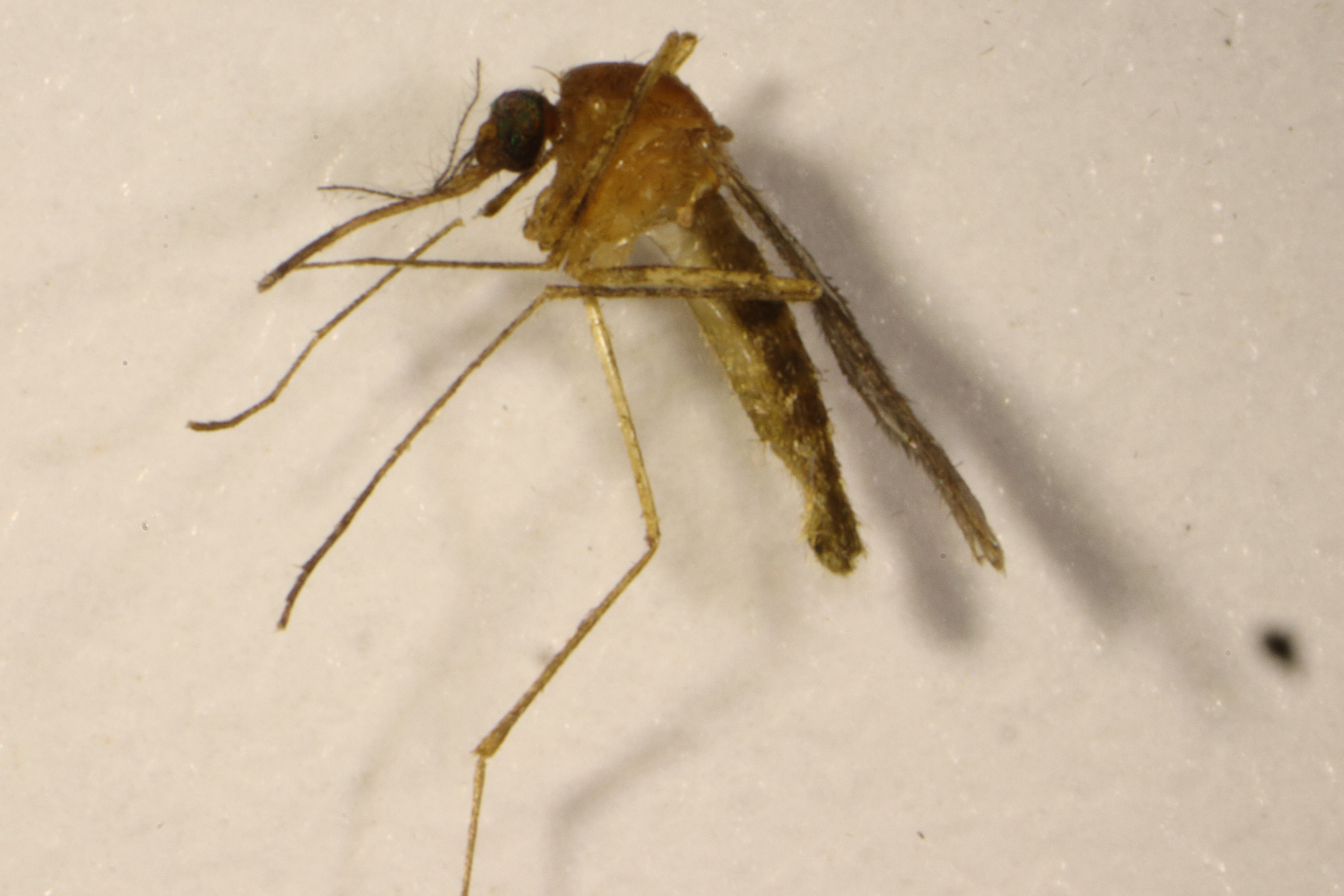
Lateral-view specimen showing several features consistent with Culex: (1) Abdomen tip appears blunt and rounded rather than pointed, which is the single most diagnostic character separating Culex from Aedes/Ochlerotatus; (2) Scutum appears uniformly brown with no silver lyre-shaped stripe or bold pale median stripe, ruling out Aedes s.s. and Stegomyia; (3) Legs appear predominantly brown/golden with at most faint pale banding — no crisp black-and-white tarsal rings visible as expected in Aedes aegypti or albopictus; (4) Wings appear to carry uniform brown-tan scaling without mottling, ruling out Mansonia/Coquillettidia and Culiseta; (5) Female palps are clearly much shorter than the proboscis, ruling out Anopheles; (6) Body size appears medium (~4–5 mm), inconsistent with the very large Psorophora or very small Uranotaenia. The overall coloration — warm golden-brown thorax, brownish abdomen with narrow pale basal bands — is typical of the Culex pipiens/quinquefasciatus complex. Confidence is moderated to 0.72 due to: specimen appears somewhat damaged/desiccated with wings folded against the body obscuring full wing venation; the lateral-only view prevents examination of the dorsal scutal pattern and abdominal banding pattern in detail; abdomen tip is partially obscured by wing overlap. Species-level identification is not possible from this image alone.
Model: claude-sonnet-4-6
• 95 Apr 2026
Specimen Biology
| Life Stage | adult |
| Condition | good |
Collection Data
| Site | BFS |
| Collection Date | 95 April 2026 |
Preservation & Curation
| Preservation | dry pinned |
Imaging
| Body Part Imaged | whole body |
Researcher Notes
Lateral-view specimen showing several features consistent with Culex: (1) Abdomen tip appears blunt and rounded rather than pointed, which is the single most diagnostic character separating Culex from Aedes/Ochlerotatus; (2) Scutum appears uniformly brown with no silver lyre-shaped stripe or bold pale median stripe, ruling out Aedes s.s. and Stegomyia; (3) Legs appear predominantly brown/golden with at most faint pale banding — no crisp black-and-white tarsal rings visible as expected in Aedes aegypti or albopictus; (4) Wings appear to carry uniform brown-tan scaling without mottling, ruling out Mansonia/Coquillettidia and Culiseta; (5) Female palps are clearly much shorter than the proboscis, ruling out Anopheles; (6) Body size appears medium (~4–5 mm), inconsistent with the very large Psorophora or very small Uranotaenia. The overall coloration — warm golden-brown thorax, brownish abdomen with narrow pale basal bands — is typical of the Culex pipiens/quinquefasciatus complex. Confidence is moderated to 0.72 due to: specimen appears somewhat damaged/desiccated with wings folded against the body obscuring full wing venation; the lateral-only view prevents examination of the dorsal scutal pattern and abdominal banding pattern in detail; abdomen tip is partially obscured by wing overlap. Species-level identification is not possible from this image alone.